

 You will be talking to the Steven Palmieri practice.






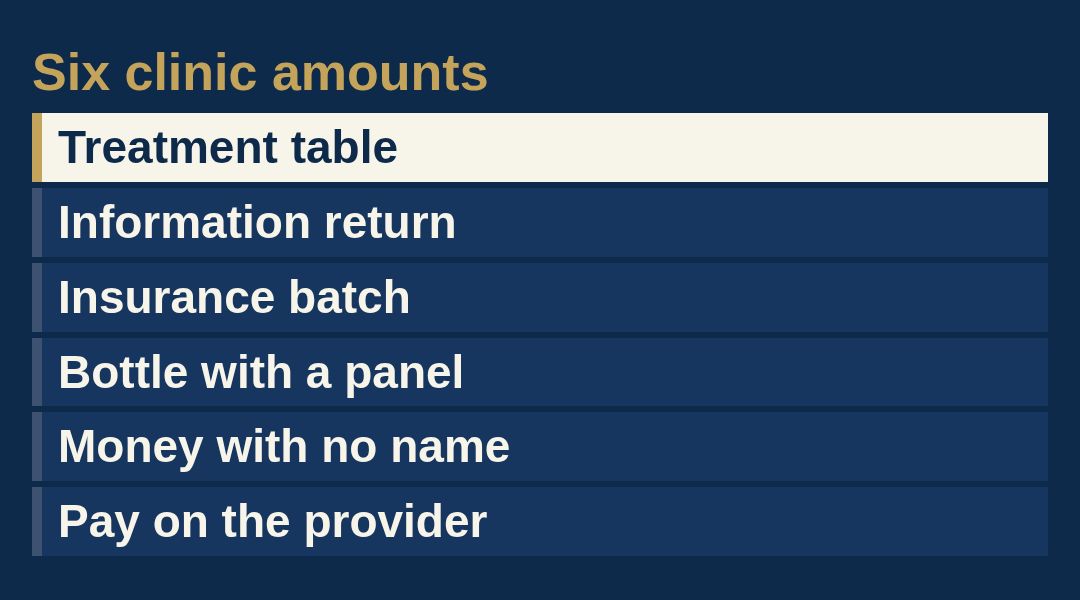


Three amounts, then the month
A clinic deposit that can be trusted shows the visit, the product that left with the patient, and the fee a card company or a processor kept. Glue two of those amounts into one and the month can look done while the margin is still unknown.
Why the label is a filing fact
Open a row under the picture when you want the longer note. A closed row can stay closed. The reason waits inside it.
What the patient was charged for the visit is a service amount. What left in a bag, when the bag carries a Drug Facts panel or a Supplement Facts panel, is a product. The same hour can hold both, and the books can still show two lines. When the whole afternoon is entered as one sales number, the bottle never becomes its own amount, and the visit looks as if it earned the shelf too.
We start from the label. If the panel is there, the item is a product and it leaves the visit line. If the paperwork for that sale is missing, the line stays open. A missing product cost stays missing. An invented product cost would only fake a split, so the gap stays visible. Open the visit page when you want those two lines written out. Dressings, supplements, and a bottle that fails the panel are on the label page.
The state where the clinic sits decides which of those lines is taxed. These pages do not print a percent, because that percent moves. The figures for one state are kept on the owners page, off the national pages. Across states, the habit we keep is the set of lines.
Where the insurance batch disagrees
A batch from an insurer is not the same object as a day sheet. The processor may keep a fee. A deposit can land the morning after the encounters. Before the month is trusted, the close names the rule the clinic uses. Record the encounter on the day the patient was seen, or record it on the day the cash landed. Use one of those two. Pick one and keep it. Change the rule halfway through a month and the same deposit can be counted twice.
An amount the receipt called tax is not part of visit income. It sits as an amount collected until it is sent on. The batch and the day sheet is the note for that gap. A clean month is the list of what has to agree before the month is trusted.
What the first call needs
One day sheet is enough. We want the encounters, the shelf sales if any are on it, and the deposit that is supposed to match. One afternoon shows whether a visit and a bottle are sharing a line. A year of files can wait. When the month is only one sales total and one deposit, we say that plainly. If the papers cannot support a split, we leave the month looking like one total.
Once that call is done, we close each month, tie the accounts, prepare statements, get pay ready on the company the clinic already hired, and hold the return until those months are closed. That company still runs payday after the books are finished. Ask a firm that is allowed to sign if you need an audit report, a review report, or a compilation. The page that draws the line is where those limits are written out.
A rate that changes when July starts
Miles between clinics, or from a clinic to a patient who is seen at home, are not a day sheet. A business mile dated on or before 30 June 2026 counts at 72.5 cents. Cite IR-2025-128 with Notice 2026-10 for that half. From 1 July it is 76 cents, from IR-2026-29 and Announcement 2026-11. Keep last winter's cent on a July trip and the second half of the log is wrong. The drive from home to the clinic and back does not go in that log. The note is the table and the miles.
Buying a treatment table raises a different return question than logging a mile. Supplies are used up. A table still in the clinic next summer can be equipment. The choice to expense it is made on the return. The code on the bill does not make that choice. Revenue Procedure 2025-32 prints the ceiling for a tax year that starts in 2026.
What we leave off the page
These examples leave out patient names, afternoon totals, and town names. A clinic here is any clinic. A visit, a labeled bottle, a dressing, an insurance batch, and a fee a card company kept are composites. A clinic can use the examples in any state, because a service charge and a product charge stay different even where both are taxed alike.
Every cent and every ceiling on these pages points at the government page that printed it. The notice for that half of the year is what sets the mileage cents. The ceiling for expensing is the one Revenue Procedure 2025-32 prints. The threshold on an information return is whatever that form's instructions print for the year. No publisher, no number. Medical payments and the form that carries them are on which form. Pay that the clinic's own company will run is on pay setup.